Local Government re-organisation
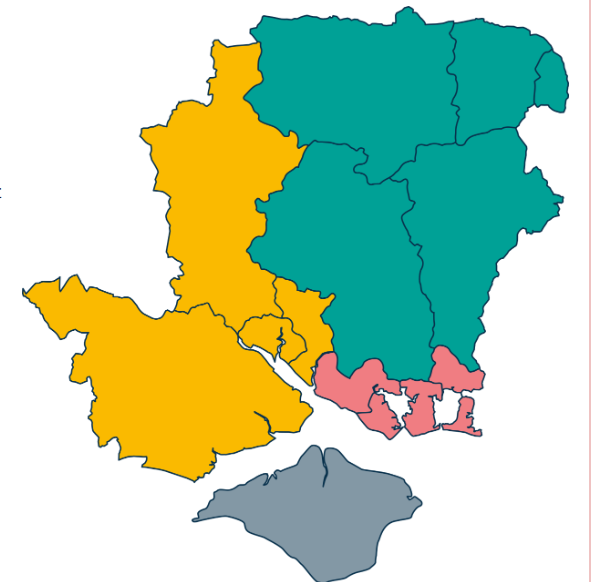
| As previously advised, the Government plans to replace the current two-tier system of councils with larger unitary authorities with responsibility to deliver all the services for their area. The Government is now undertaking a consultation on the 4 proposals submitted by Hampshire local authorities. We are particularly concerned about one of the proposals (fully explained below) but briefly, we believe this would result in a unitary authority much too large to be able to properly deliver services to Hook. We therefore urge you to respond to this consultation. Our summary on the proposals: Hampshire County Council and East Hampshire District Council have proposed a model of four, mainland councils across the county. Under this proposal Hart would be joined with Basingstoke and Deane, Rushmoor, Winchester and East Hampshire, Eleven other councils including Hart worked together and produced three variant proposals. In all three, Hart is only joined with Basingstoke and Deane and Rushmoor. (The differences between the other variants are in the composition of the other proposed unitary authorities). Hart and the ten other councils, all support a five-unitary model as the best fit for our area to keep services local and deliver at least £63.9m a year of savings. Further detail is at Find out more information about our proposals. The composition of each unitary authority for each proposal is given in the preamble to the questionnaire/consultation. The proposal giving us concern is the proposal by Hampshire County Council and East Hampshire District Council. Its proposed unitary authorities are illustrated in the following link: https://hookdevaction.org.uk/wp-content/uploads/2025/12/Gvt-Reorg.png We strongly believe that this unitary authority proposed by Hampshire County Council and East Hampshire District Council containing Hart is far too large for the effective provision of local services. For example, is it really credible to assume that, in future, planning decisions about Hook, which would be made in Winchester, would really reflect our local environment? If you agree with our concerns we would urge you to respond to the consultation. To add some extra context, when reviewing plans for Surrey it appears the Government favours larger unitary authorities so it is important that as many people as possible respond in order to request smaller authorities likely more able to manage effective provision of local services. Unfortunately, the consultation questionnaire does not ask the simple question of what proposed re-organisation do you prefer. For each proposal it asks the same series of questions each in similar vein to the first one reproduced below: “To what extent do you agree or disagree that the proposal suggests councils that are based on sensible geographies and economic areas?” It then only allows you to select from the following answers: strongly agree agree neither agree nor disagree disagree strongly disagree don’t know You will need to carefully select appropriate responses to clearly make your preferences known on each proposal. Additionally, the first section of the questionnaire within the consultation asks for personal information. When answering as an individual there is no need to answer questions 5, 6 and 7. Confusingly when you complete this section and then go to complete every other section, the questionnaire always goes back to the very beginning which says, “Please click on and complete the first section to tell us about yourself”. It does this even if you answer every question in that first section, so ignore and scroll down to the link to the next section to be answered. We hope this heads-up on handling the question process will help you navigate the consultation and help you to persevere through to have your say. The consultation is at https://consult.communities.gov.uk/local-government-reorganisation/hampshire-isle-of-wight-portsmouth-southampton The consultation closing date is Sunday 11 January 2026. The Government will review the proposals and questionnaire responses and subject to parliamentary approval, expect new unitary councils to take on full council roles from April 2028, with transitional arrangements in 2027-28 to support a smooth implementation. Thanks for taking the time to read through this. |